_edited.jpg)
The Procrastination Course
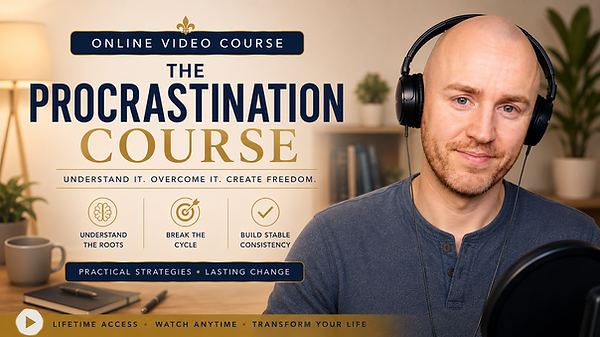
Course Details: This course consists of 14 core video lessons with over 4 hours of content. You'll receive lifetime access and can work through the material at your own pace.
If you've struggled with procrastination for any length of time, you've probably already discovered that the problem isn't a lack of information. You know what you should do, and you may genuinely want to do it, yet something seems to get in the way.
In this course, you'll learn a completely different way of understanding procrastination, one that focuses on the underlying psychological dynamics rather than discipline, motivation, or productivity hacks. Because our ability to follow through affects every area of life, I recommend this course as the foundation for much of the work I teach.
I almost feel the need to apologize for what I'm about to say because I know how unbelievable it may sound.
After years of struggling with procrastination myself, studying it extensively, and working with many clients who faced the same challenge, I have come to a conclusion that I never expected to reach:
I no longer believe that chronic procrastination is a particularly difficult problem to overcome.
I realize that statement may sound surprising, especially if you've spent years trying different productivity systems, motivational techniques, accountability structures, or forms of self-discipline without lasting success.
The reason I say it is because I have personally used the principles taught in this course and no longer experience procrastination as an ongoing issue in my life. More importantly, I have watched many clients arrive at a similar place. Not because they became more disciplined or developed extraordinary willpower, but because they finally understood what was actually causing the problem.
Once the underlying dynamics become clear, the struggle often becomes far simpler than people imagine. What previously felt confusing, frustrating, and deeply entrenched begins to make sense.
Of course, everyone is different, and I can't promise that your experience will mirror mine exactly. What I can say is that I have yet to find a better explanation for chronic procrastination, or a more effective approach to overcoming it, than the one I teach in this course.
That's a bold statement, and I don't expect you to take it on faith. My hope is simply that you'll work through the material and decide for yourself.
This course provides a complete framework for overcoming procrastination. This is not a course about forcing yourself to work harder. It is a comprehensive framework for understanding why procrastination happens in the first place and what to do about it.
Over more than four hours of material, we'll explore the psychological dynamics that drive procrastination, the myths that keep it alive, and the practical tools that make consistent action feel dramatically easier.
Here's what you'll find in the course...
Part 1 centers on understanding why you've been stuck. Most people begin with the assumption that they procrastinate because they are lazy, undisciplined, or lacking motivation. In the opening section of the course, we'll challenge these assumptions and explore a very different explanation.
You'll learn why traditional advice often fails, how limiting beliefs are formed, why action is an effect rather than a cause, and how certain ideas about productivity can unknowingly keep you trapped in a cycle of avoidance.
Most importantly, you'll begin to understand that procrastination is not a character flaw. It is the result of an internal conflict that can be understood and resolved.
Part 2 looks at changing the relationship you have with yourself. Once we understand the problem, we can begin addressing it. This section introduces some of the most important concepts in the entire course, including the inner struggle between the parts of the mind that want different things and the role self-talk plays in maintaining procrastination.
We'll examine how self-criticism, pressure, obligation, and internalized beliefs create resistance, and how a more compassionate and effective relationship with yourself can dramatically reduce that resistance.
We'll also dismantle many of the myths people have been taught about success, discipline, achievement, planning, credentials, sacrifice, and productivity.
Next, in part 3, we look at practical tools for lasting change. Understanding procrastination is important, but understanding alone is not enough. In this section, you'll learn a range of practical techniques designed to create genuine change in day-to-day life.
These include the Story Technique, journalling approaches, gratitude exercises, forgiveness practices, and methods for identifying and questioning beliefs that create emotional resistance.
The goal is to give you a practical toolkit that can be adapted to your own personality and circumstances.
The practical side of taking action is examined in part 4. Many people know what they want to do but struggle when it comes to planning and execution. Here, we look at the practical side of overcoming procrastination.
You'll learn how to create plans that support action rather than create overwhelm, why fun and enjoyment are essential rather than optional, how to structure tasks so they feel achievable, and how to build momentum without relying on pressure or willpower.
Part 5 looks at the boundary technique. At the heart of the course is one of the most powerful concepts I have ever discovered for overcoming procrastination. The Boundary Technique addresses the hidden dynamic that keeps people trapped in endless cycles of delaying, negotiating, and promising themselves they will start later.
For many students, this concept alone has been transformative.
Finally, In part 6, we take a look at maintaining progress in life. We'll look at how to deal with overwhelm, competing priorities, and the challenges that arise when working toward meaningful goals over the long term.
You'll learn how to maintain focus without feeling deprived, how to balance multiple interests without becoming overwhelmed, and how to continue moving forward in a way that feels sustainable and enjoyable.
The course concludes with bonus lessons, real-world examples, case studies, and a clear roadmap for continuing your progress long after the course has ended.
Who Is This Course For? This course is designed for people who find themselves repeatedly struggling to follow through on the things that matter most to them. You may have goals you genuinely care about, projects you desperately want to complete, or responsibilities you know would improve your life if you could consistently engage with them. Yet despite your best intentions, something seems to get in the way.
Perhaps you've spent years trying to become more disciplined. You've experimented with productivity systems, time-management techniques, accountability structures, motivational videos, habit trackers, or carefully designed schedules. Some of these approaches may have helped temporarily, but the underlying problem always seemed to return.
You may feel frustrated because you know exactly what you should be doing. The issue isn't a lack of knowledge. In many cases, people who struggle with procrastination are highly self-aware, and deeply motivated to improve their lives. What they often lack is an accurate understanding of why they are procrastinating in the first place.
This course is particularly suited to people who are tired of fighting with themselves. If you've reached the point where self-criticism, pressure, guilt, and endless promises to "start soon" no longer seem to be working, you'll likely find a very different perspective here.
Whether procrastination is affecting your career, business, studies, creative projects, health, relationships, or personal growth, the principles taught in this course are designed to help you understand the psychological dynamics underneath the struggle. Once those dynamics become visible, lasting change often becomes far more achievable than most people imagine.
If you've spent years believing that you're lazy, undisciplined, broken, or somehow lacking the qualities that successful people possess, my hope is that this course will offer a different explanation, one that is both more accurate and considerably more hopeful.
Hi David, just wanted to tell you I worked 6h 55m yesterday and could not stop working (record for a long time). I felt amazing and it was so fun to work. There was no pressure or anxiety. Thanks sooo much! Your method works like magic :)
Daniels
“I’ve been implementing some of the concepts already and they have been very helpful. Specifically, the Non-negotiable play time, and using no work as a punishment for missing a deadline. Both have been a game changer so far.”
Michael
